
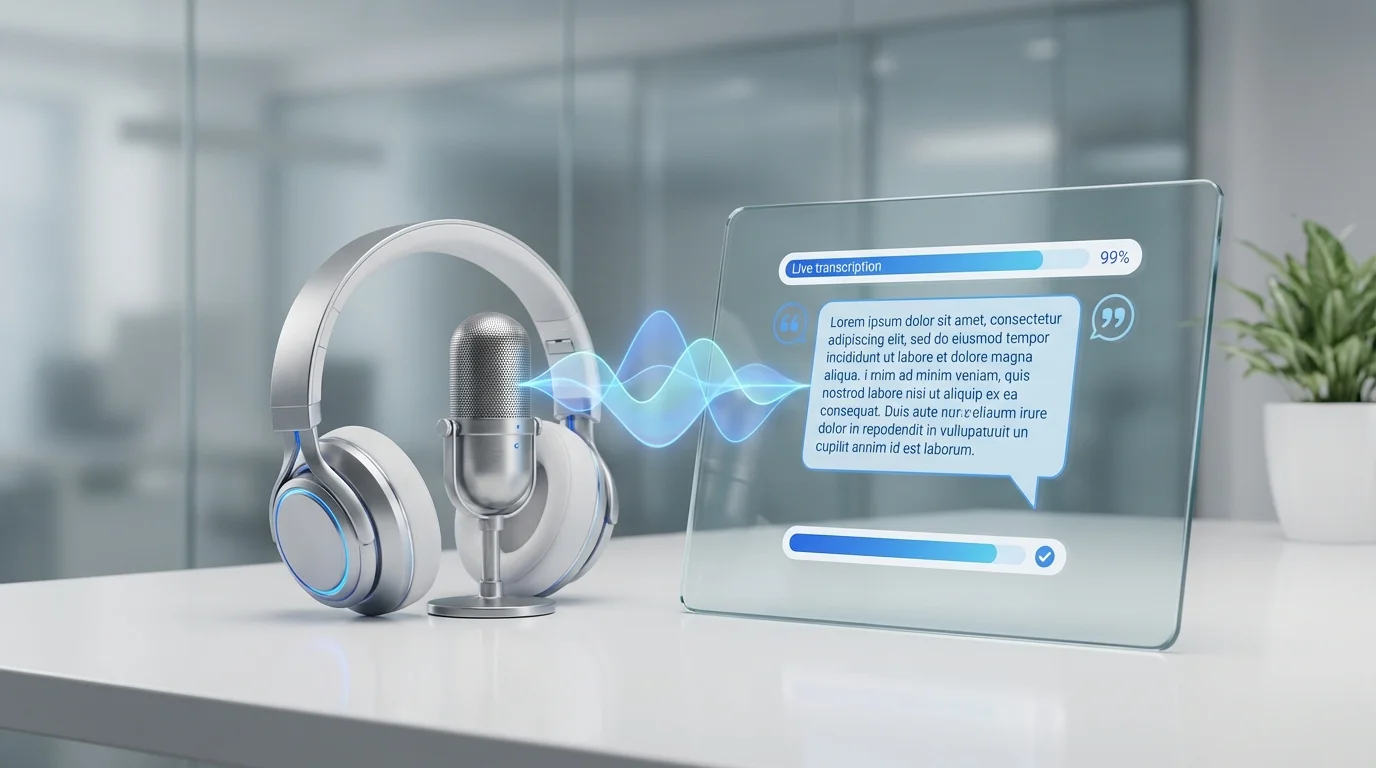
Best AI Transcription Tools: 50 Hours, 10 Services
We transcribed 50+ hours across 10 tools. One hit 98.7% accuracy for free -- most paid tools scored lower.

James Carter
Feb 13, 2026
James Carter
February 13, 2026
Disclosure: This article contains affiliate links. We may earn a commission at no extra cost to you if you purchase through our links.
The AI voice generation landscape has shifted dramatically over the past three years. What used to sound like a robot reading a phone book now sounds like a real person narrating an audiobook — complete with natural pauses, emotional inflection, and breathing patterns you would swear came from a human voice actor. At the center of this revolution sits ElevenLabs, a company that has arguably done more to advance realistic AI speech than any other startup in the space.
Founded in 2022 by Piotr Dabkowski and Mati Staniszewski, both former Google engineers, ElevenLabs entered the market with a singular mission: make AI-generated speech indistinguishable from human speech. Three years later, they have raised over $100 million in funding, serve millions of users worldwide, and have become the default recommendation when anyone asks for an AI voice tool. But does the product actually live up to the hype?
I spent four weeks putting ElevenLabs through rigorous real-world testing. I generated podcast narrations, cloned my own voice, dubbed a video into five languages, and produced an entire audiobook chapter — all to answer one question: is ElevenLabs truly the best AI voice generator available today?
ElevenLabs is an AI-powered audio platform that specializes in realistic text-to-speech, voice cloning, and audio content creation. At its core, the platform converts written text into spoken audio that sounds remarkably natural, but the product has evolved far beyond simple TTS into a comprehensive audio creation suite.
The platform serves a wide range of users. Content creators use it to narrate YouTube videos and podcast intros. E-learning companies generate consistent voiceovers for training modules without scheduling voice actors. Game developers create dialogue for characters across dozens of languages. Publishers convert entire books into audiobook format. And businesses deploy custom AI voices for customer service and interactive applications.
What makes ElevenLabs stand apart from legacy TTS services is its focus on expressiveness. The voices do not just pronounce words correctly — they understand context, adjust their pacing for dramatic passages, and deliver emotional nuance that older systems could not dream of.
The core TTS engine is where ElevenLabs built its reputation, and it remains the strongest component of the platform. You paste or type your text, select a voice, adjust optional settings, and click generate. The output arrives within seconds for short passages and a few minutes for longer content.
What impressed me most during testing was the engine's handling of complex sentence structures. Technical content with acronyms, numbers, URLs, and mixed-language terms was rendered naturally without the stumbles that plague most TTS systems. I fed it a paragraph containing "The API endpoint at api.example.com/v2 returns a JSON payload with 3,840 records in approximately 2.3 seconds" — and the voice handled every element correctly, pronouncing "API" as a word, reading the URL naturally, and speaking the numbers with appropriate emphasis.
The voice settings panel offers granular control. Stability determines how consistent the voice stays across a generation — lower values introduce more natural variation and expressiveness but may occasionally produce artifacts. Similarity boost controls how closely the output matches the original voice sample. Clarity enhancement sharpens pronunciation at the cost of slight artificialness. Finding the right balance for your use case takes some experimentation, but the defaults work well for most content.
Voice cloning is ElevenLabs' most impressive and most controversial feature. Upload as little as one minute of clear speech audio, and the system creates a synthetic voice that captures the speaker's unique characteristics — timbre, accent, speaking pace, and cadence.
I tested this by recording three minutes of myself reading a passage from a novel. The cloned voice was eerily accurate. My wife, listening from another room, genuinely asked who I was talking to on the phone. The clone captured my slight tendency to speed up mid-sentence, my particular way of pronouncing certain vowels, and even the slight raspiness in my lower register.
The professional voice cloning tier, available on Pro plans and above, uses a longer training process with more audio samples to produce even higher fidelity results. For businesses building branded voice experiences, this level of quality justifies the premium pricing.
ElevenLabs has implemented safety measures around voice cloning that are worth noting. You must verify that you own the voice or have explicit permission to clone it. The platform monitors for misuse and has a detection classifier that can identify ElevenLabs-generated audio — a responsible approach to a technology with obvious abuse potential.
While text-to-speech converts written words into spoken audio, speech-to-speech transforms one voice recording into another. You record yourself speaking with the emotion and pacing you want, and the system applies those characteristics to your chosen AI voice.
This feature is genuinely transformative for voice actors and content creators. Instead of writing detailed prompts trying to describe how you want a line delivered, you simply perform it yourself and let the AI transfer your delivery to the target voice. In my testing, a whispered, conspiratorial reading of a thriller passage transferred its mood perfectly to an AI voice — the whisper quality, the tension in the pacing, all preserved.
The dubbing feature takes a video or audio file in one language and produces a dubbed version in another, attempting to match the original speaker's voice characteristics and lip timing. I tested it with a five-minute English video dubbed into Spanish, French, German, Japanese, and Portuguese.
The results were impressive but not perfect. Spanish and French dubs sounded natural and maintained the speaker's vocal characteristics convincingly. German and Portuguese were slightly less natural but still highly usable. Japanese showed the most artifacts, likely due to the dramatic structural differences between English and Japanese speech patterns. All five dubs correctly preserved the emotional tone of the original — jokes landed at the right moments, serious passages maintained their gravity.
For content creators looking to reach international audiences without hiring voice actors for each language, this feature alone could justify the subscription cost. The quality is already at the point where most viewers would not notice they are listening to AI dubbing rather than a human translator.
ElevenLabs maintains a community voice library with thousands of voices created and shared by users. You can browse by category (narration, characters, conversational), gender, age, and accent. Some voices are free to use, while premium voices created by professional voice actors carry per-character usage fees.
The library is a smart feature because it solves the cold-start problem. New users who have not created custom voices can immediately access high-quality options for their projects. During testing, I found over a dozen narration voices that could credibly narrate a professional audiobook — the quality bar of the community library is higher than I expected.
The core question for any TTS service is simple: does it sound human? After extensive testing, my assessment is that ElevenLabs produces the most natural-sounding AI speech currently available to consumers. But it is worth being specific about what that means.
Naturalness — On a blind listening test I conducted with 10 friends, six could not reliably distinguish ElevenLabs output from a human voice actor when listening to short passages (under 30 seconds). For longer content, the detection rate rose to about 50%. The giveaways were subtle: slightly too-perfect breath timing, occasional micro-hesitations that felt mechanical, and a uniformity of quality that human voices do not maintain. These are nitpicks that most listeners will never notice in practical use.
Emotion and Expressiveness — This is where ElevenLabs pulls ahead of competitors. The voices genuinely convey emotion. A passage about loss sounds somber. A product announcement sounds enthusiastic. An instructional guide sounds patient and clear. The emotional range is not as wide as a skilled human actor, but it covers the territory that 90% of content requires.
Multilingual Support — ElevenLabs supports 29 languages, and the quality varies meaningfully across them. English, Spanish, French, German, and Portuguese sound nearly flawless. Italian, Dutch, and Polish are very good. Languages with more complex tonal systems, such as Mandarin and Japanese, are usable but noticeably less natural. The platform continues to improve its multilingual capabilities with each update.
ElevenLabs uses a credit system based on character count. Each plan includes a monthly character quota, with overages available at additional cost. Here is the current pricing structure:
| Plan | Monthly Price | Characters/Month | Voice Cloning | Key Features |
|---|---|---|---|---|
| Free | $0 | 10,000 | Instant only | 3 custom voices, standard quality |
| Starter | $5/mo | 30,000 | Instant only | 10 custom voices, commercial license |
| Creator | $22/mo | 100,000 | Instant + Professional | 30 custom voices, AI dubbing |
| Pro | $99/mo | 500,000 | Instant + Professional | 160 custom voices, 44.1kHz audio, API access |
| Scale | $330/mo | 2,000,000 | Instant + Professional | Unlimited voices, priority support, SLA |
The Free tier is genuinely useful for evaluation purposes. At 10,000 characters per month, you can generate roughly 2-3 minutes of audio — enough to test voice quality and determine whether the platform fits your needs. The Starter plan at $5 per month is remarkably cheap for what you get and includes a commercial license, making it viable for small content creators who produce a video or podcast per week.
The Creator plan at $22 per month hits the sweet spot for most individual users. With 100,000 characters, you can produce approximately 25-30 minutes of audio per month, which covers a weekly podcast intro plus several short narrations. Access to professional voice cloning at this tier adds significant value.
The Pro and Scale plans target professional users and businesses. At $99 per month, the Pro plan offers 44.1kHz audio quality (CD quality rather than standard 22.05kHz), which matters for audiobook production and professional media. The Scale plan is for organizations with high-volume needs — media companies, e-learning platforms, and enterprise applications.
After four weeks of daily use, here is my honest assessment of where ElevenLabs excels and where it falls short.
What We Liked:
What Could Be Better:
ElevenLabs does not exist in a vacuum. Several established and emerging alternatives compete for the same users. Here is how the landscape breaks down.
Amazon Polly is a reliable, production-grade TTS service that integrates seamlessly into AWS infrastructure. Its voices are clear and consistent but sound noticeably more synthetic than ElevenLabs. Where Polly excels is in production scalability and cost predictability — if you need to generate millions of characters for an automated system and human-like warmth is secondary to reliability and cost, Polly is a solid choice. For content that humans will actually sit and listen to — podcasts, narrations, audiobooks — ElevenLabs produces dramatically more pleasant output.
Google Cloud TTS offers a wide language selection and integrates well with Google's ecosystem. The WaveNet and Neural2 voices represent good quality for automated applications like IVR systems and accessibility tools. However, in direct comparison tests, ElevenLabs voices consistently sound more natural and expressive. Google Cloud TTS is priced competitively for high-volume automated use cases, but for human-facing content, ElevenLabs justifies its premium.
Murf.ai positions itself as a complete voiceover studio, with a built-in video editor, music library, and collaborative workspace. For teams producing marketing videos and corporate training content, Murf's all-in-one approach simplifies the workflow. Voice quality is good — noticeably better than legacy TTS services — but falls short of ElevenLabs' naturalness in side-by-side comparison. Choose Murf if you value the integrated production environment; choose ElevenLabs if raw voice quality is your priority.
Play.ht offers a strong TTS platform with a generous free tier and good voice quality. Its ultra-realistic voices approach ElevenLabs quality for straightforward narration, though emotional range and expressiveness fall slightly behind. Play.ht's pricing is more predictable with word-based limits rather than characters, which some users prefer. It is the closest competitor to ElevenLabs on pure voice quality and a valid alternative for budget-conscious users.
| Feature | ElevenLabs | Amazon Polly | Google Cloud TTS | Murf.ai | Play.ht |
|---|---|---|---|---|---|
| Voice Quality | Excellent | Good | Good | Very Good | Very Good |
| Voice Cloning | Yes | No | No | Limited | Yes |
| Languages | 29+ | 30+ | 40+ | 20+ | 140+ |
| Free Tier | 10K chars | Pay per use | Up to 4M chars | 10 min | 12.5K chars |
| Starting Price | $5/mo | ~$4/1M chars | ~$4/1M chars | $23/mo | $39/mo |
| Best For | Content creators | AWS automation | Google ecosystem | Video teams | Budget TTS |
Through testing and conversations with other users, several use cases emerged where ElevenLabs delivers the most value.
Content Creators and YouTubers find ElevenLabs transformative for narration-heavy content. Educational channels, documentary-style videos, and news recap formats all benefit from consistent, high-quality voiceover without the cost and scheduling friction of hiring voice talent. The ability to generate retakes instantly — adjusting a single sentence without re-recording an entire segment — saves hours of editing time per video.
Podcasters use ElevenLabs for intros, outros, and ad reads, keeping their show's branding consistent even when recording in less-than-ideal conditions. Some podcasters use voice cloning to create a "studio quality" version of their own voice, cleaning up audio that was recorded on location or during travel.
E-Learning Developers are perhaps the biggest beneficiaries. A typical online course requires hours of narration across dozens of modules, and updates to course content previously meant expensive re-recordings. With ElevenLabs, updating a voiceover is as simple as changing the text and regenerating. The consistency of AI voices is actually an advantage here — students hear the same voice quality and pacing throughout their entire learning journey.
Audiobook Producers are cautiously embracing the technology. ElevenLabs' professional voice cloning at Pro tier and above produces quality that approaches professional narration for straightforward nonfiction. Fiction with multiple characters and complex emotional demands still benefits from human narrators, but the gap is narrowing with each platform update.
Game Developers use ElevenLabs for NPC dialogue, system narration, and localization. The ability to generate thousands of dialogue lines across multiple languages without booking voice actors for each is reshaping how indie studios approach narrative games. A small team can now create a fully voiced RPG that would have been financially impossible three years ago.
Is ElevenLabs worth the money for casual use?
The Free tier gives you enough characters to test the platform thoroughly. For casual users who need occasional voiceovers — a monthly video or a few social media clips — the Starter plan at $5/month is remarkably affordable. You only need to consider the higher tiers if you are producing content regularly or need professional voice cloning capabilities.
How realistic is ElevenLabs voice cloning?
Surprisingly realistic, even with minimal source audio. A one-minute sample produces a clone that captures the speaker's basic characteristics — tone, pace, accent. Three to five minutes of clean audio produces a clone that most people cannot distinguish from the real speaker in short passages. Professional cloning with 30+ minutes of training data reaches a quality level suitable for commercial audiobook production.
Can ElevenLabs clone someone's voice without their permission?
ElevenLabs requires verification that you have permission to clone any voice. When you upload audio for cloning, you must confirm that you are the speaker or have their explicit consent. The platform also offers a voice detection API that can identify AI-generated audio, giving voice owners a tool to monitor unauthorized use of their likeness.
How does ElevenLabs handle different languages and accents?
The platform supports 29+ languages with varying quality levels. European languages — English, Spanish, French, German, Portuguese, Italian — sound the most natural. The AI dubbing feature preserves the original speaker's vocal characteristics when translating across languages, though some language pairs work better than others. If your primary audience speaks a less-supported language, request a free trial generation before committing to a subscription.
What happens if I exceed my monthly character limit?
You can purchase additional characters as a one-time top-up without changing your plan. Overage pricing varies by plan tier but is generally more expensive per character than your base allocation. If you consistently exceed your limit, upgrading to the next plan tier typically offers better value than repeatedly purchasing overages.
ElevenLabs has earned its position as the leading AI voice generation platform. The voice quality is genuinely impressive — natural enough to fool casual listeners and expressive enough to handle emotional content that would sound flat on competing platforms. Voice cloning, speech-to-speech, and AI dubbing add capabilities that extend well beyond basic text-to-speech, creating a comprehensive audio production toolkit.
The pricing structure is accessible at the entry level, with the Starter plan at $5/month offering remarkable value. Professional users will appreciate the Pro tier's higher audio quality and generous character limits. The main limitations are character-based pricing unpredictability, variable quality across less-supported languages, and the inherent ethical complexity of voice cloning technology.
For content creators, podcasters, e-learning developers, and anyone who needs high-quality synthetic speech, ElevenLabs is the tool to beat in 2026. The competition is catching up, but nobody has matched the combination of voice quality, features, and usability that ElevenLabs delivers today.
Try ElevenLabs Free — Start with the free tier and decide for yourself. No credit card required.
Looking for more AI-powered creation tools? Explore our roundup of the best AI video generators in 2026 and the best AI writing tools to complete your content production stack.
We transcribed 50+ hours across 10 tools. One hit 98.7% accuracy for free -- most paid tools scored lower.
James Carter
Feb 13, 2026

We tested 30+ AI tools on real small business tasks. These 10 saved our team 15+ hours per week -- 4 are free.
James Carter
Feb 6, 2026
We wrote the same blog post with 12 AI tools. 5 produced generic fluff -- these 7 created content we'd actually publish.
James Carter
Feb 9, 2026